Beyond the Numbers: What Your Sleep Tracker *Really* Tells You About Your Circadian Rhythm
A sleep tracker can tell you when you probably fell asleep, how long you stayed in bed, and how your estimated sleep stages changed overnight. But sleep tracker data interpretation becomes much more useful when you connect those numbers to your circadian rhythm: the internal timing system that helps coordinate sleep, alertness, hormone release, body temperature, and other daily biological processes.
Two people can record the same eight hours of sleep and experience very different mornings. One may wake naturally, feel alert, and maintain steady energy. The other may struggle to get moving despite an apparently impressive sleep score. Duration matters, but timing, regularity, light exposure, and the relationship between sleep and the body's internal clock also matter.
1. Understand What Your Circadian Rhythm Actually Controls
Your circadian rhythm is an approximately 24-hour biological timing system coordinated by a network of internal clocks. A central pacemaker in the brain, the suprachiasmatic nucleus, receives information about environmental light and helps synchronize rhythms throughout the body.
This system influences when you naturally feel sleepy or alert, the timing of melatonin production, daily body-temperature patterns, and other physiological processes. It does not work alone. Sleep is also governed by homeostatic sleep pressure, which builds while you are awake and decreases as you sleep.
These two processes explain why sleep timing can be more complicated than simply going to bed when you feel tired.
- Circadian timing: Influences the periods when your body is biologically more prepared for sleep or wakefulness.
- Sleep pressure: Builds with time awake and generally makes sleep more likely as the day progresses.
- Environmental cues: Morning daylight, evening illumination, meals, physical activity, and work schedules can influence daily timing and routines.
For example, staying awake late may create substantial sleep pressure, allowing you to fall asleep quickly even when the timing conflicts with your preferred schedule. That does not necessarily mean your circadian rhythm is optimally aligned.
Similarly, sleeping later on weekends may compensate for insufficient weekday sleep. It may also create a recurring difference between your workday schedule and your preferred biological timing. A tracker can help reveal that difference, but it cannot independently determine the precise phase of your internal clock.
Why a high sleep score can hide a timing problem
Many wearable devices combine estimated duration, movement, heart rate, and other signals into a single score. The scoring method varies by manufacturer, and a high score does not establish that your sleep occurred at the most appropriate biological time.
Imagine that you consistently sleep from 2 a.m. to 10 a.m. and feel rested. If your schedule fits your life and remains stable, those hours may work well for you. Now imagine that you sleep from 2 a.m. to 6 a.m. on workdays and from 3 a.m. to 11 a.m. on weekends. The problem is no longer just bedtime. It includes restricted duration and a shifting schedule.
The practical distinction is important: look for alignment between your sleep pattern, your obligations, your natural tendencies, and your daytime functioning rather than trying to imitate someone else's ideal bedtime.
2. Read Sleep and Wake Consistency Before Chasing Sleep Stages
Of the measurements commonly available on a wearable sleep monitoring device, the estimated timing of sleep onset and final awakening is often a more actionable starting point than nightly deep-sleep or REM percentages.
Record your actual sleep and wake times over at least two weeks, ideally including both workdays and free days. Four weeks can reveal additional patterns if your schedule changes from week to week. The goal is not to produce a perfect graph. It is to determine whether your sleep timing is stable, drifting, or repeatedly interrupted by external demands.
What regularity looks like in practice
Suppose your tracker records the following approximate sleep windows:
- Monday: 11:20 p.m. to 7:00 a.m.
- Tuesday: 11:35 p.m. to 7:05 a.m.
- Wednesday: 11:25 p.m. to 7:00 a.m.
- Thursday: 11:50 p.m. to 7:10 a.m.
- Friday: 12:40 a.m. to 8:15 a.m.
This schedule suggests fairly stable timing during the workweek, followed by a later Friday night and Saturday morning. That single shift is not proof of a circadian problem. It is a reason to examine what happens over the rest of the weekend and whether Monday mornings feel substantially harder.
Now consider a different pattern: bedtime moves between 10 p.m. and 2 a.m. throughout the week, while wake time remains fixed at 6:30 a.m. This creates changing sleep opportunities and may reflect late work, evening light exposure, inconsistent habits, or an underlying mismatch between preferred timing and required timing.
In either case, compare the pattern with daytime alertness. A stable schedule that leaves you chronically sleep-deprived is not a successful outcome. Regularity and adequate sleep duration must be considered together.
Use sleep midpoint to identify schedule shifts
Sleep midpoint is the halfway point between estimated sleep onset and final awakening. If you fall asleep at midnight and wake at 8 a.m., your midpoint is 4 a.m.
Comparing sleep midpoints across workdays and free days can make schedule shifts easier to see than comparing bedtimes alone. A later midpoint on free days may reflect accumulated sleep debt, a naturally later preference, or both. It is a useful descriptive measure, not a direct measurement of circadian phase.
Decision rule: If your sleep midpoint changes substantially between workdays and weekends, first examine sleep restriction, social commitments, and schedule demands. If timing remains stable but sleepiness persists, investigate duration, sleep quality, medications, and possible sleep disorders rather than assuming that circadian misalignment is the sole explanation.
3. Interpret Deep Sleep and REM Timing Without Overreading the Graph
Sleep-stage graphs can make wearable data feel more precise than it really is. Deep sleep, often called N3 sleep, and rapid eye movement (REM) sleep have different biological characteristics and tend to follow recognizable patterns across the night. Understanding those patterns is useful, but consumer devices generally estimate stages indirectly.
Deep sleep: Why early-night timing matters
In a typical consolidated night, deep sleep is more concentrated in the earlier sleep cycles. This pattern is related partly to accumulated sleep pressure. As the night progresses, deep sleep generally becomes less prominent, while REM episodes tend to become longer toward morning.
If your tracker repeatedly shows estimated deep sleep early in the sleep period, that pattern is broadly compatible with normal sleep architecture. However, a device cannot confirm the presence or exact duration of N3 sleep with the same physiological detail as a clinical sleep study using brain-wave measurements.
Consider an apparent reduction in deep sleep on nights when you go to bed much later than usual. Several explanations are possible, including a shorter recording window, disrupted sleep, alcohol exposure, stress, or differences in the algorithm's classification. A single low reading does not identify which explanation is correct.
Do not try to force more deep sleep by moving bedtime earlier without considering whether you are actually sleepy. A consistent schedule, sufficient sleep opportunity, and a suitable sleep environment are more defensible starting points than trying to manipulate one estimated stage percentage.
REM sleep: Why the end of the night matters
REM sleep is associated with vivid dreaming, memory-related processes, and other aspects of brain function. In typical adult sleep, REM periods tend to become longer during the latter portion of the night.
This has an important practical implication: cutting the last hour or two from your sleep period can remove an opportunity for later-night REM sleep, even if the first part of the night looks relatively uninterrupted.
Suppose your wearable shows several REM periods between 5 a.m. and 7 a.m., but your alarm is set for 5:30 a.m. on workdays. Rather than interpreting the graph as evidence that you need a special REM-enhancing routine, first ask whether your schedule repeatedly cuts sleep short.
Conversely, a tracker that reports unusually high REM on one night has not necessarily demonstrated a biological improvement. Estimates can shift with sleep fragmentation, device placement, algorithm updates, and the characteristics of the individual wearing the device.
Look for repeated changes, not ideal percentages
Age, individual physiology, sleep duration, medications, and health conditions can all affect sleep architecture. There is no single deep-sleep or REM percentage that should be treated as a universal target for every adult.
If the estimated stage distribution changes while sleep timing and duration remain stable, review potential contributors such as alcohol, late caffeine, stress, illness, and medication changes. If you feel well and the change appears only in the device's display, do not assume that it represents a clinically meaningful deterioration.
If a persistent change accompanies significant daytime sleepiness, unusual nighttime behavior, or breathing-related symptoms, the appropriate next step is a clinical assessment rather than increasingly aggressive attempts to optimize a graph.
4. Combine Timing With Other Tracker Metrics
Sleep onset and wake time provide the foundation, but other measurements can add context. The key is to use each metric for the question it can reasonably help answer.
Total sleep duration and time in bed
Time in bed is not the same as time asleep. A device may estimate that you spent eight hours in bed but slept for considerably less time after accounting for the time it took to fall asleep and periods of wakefulness.
For most adults, regularly obtaining at least seven hours of sleep is a useful general benchmark, although individual needs vary. The relevant question is whether your schedule provides enough sleep opportunity for you to function well and whether your estimated duration is consistent with how you feel.
If your schedule is highly irregular and sleep duration is short, prioritize protecting a sufficient sleep window before experimenting with smaller changes to evening routines.
Nighttime awakenings and sleep fragmentation
Movement-based and heart-rate-based devices can mistake quiet wakefulness for sleep or classify normal movement as an awakening. Their estimates of wake after sleep onset should therefore be treated as approximations.
Nevertheless, recurring patterns can be informative. If you consistently notice frequent awakenings after late meals, alcohol consumption, stressful evenings, or unusually warm nights, compare those observations with your sleep records. Repeated associations can suggest practical experiments, but they do not establish causation.
Resting heart rate and heart rate variability
Some wearables record overnight heart rate and heart rate variability (HRV). These signals may change with training load, illness, stress, alcohol, hydration, breathing patterns, and other factors.
A higher or lower HRV value is not automatically good or bad. Individual baselines and longer-term trends are generally more informative than comparisons with other people or isolated daily readings.
If your usual overnight heart rate rises for several nights while HRV falls and you feel unusually fatigued, consider whether illness, stress, inadequate recovery, or a change in routine might explain the combination. These metrics are nonspecific; they cannot independently diagnose a circadian disorder or a cardiovascular condition.
Environmental and behavioral context
A wearable cannot fully interpret your day unless you supply relevant context. A brief journal can capture morning light exposure, caffeine timing, alcohol, exercise, work shifts, naps, and unusual stress.
For example, if your bedtime gradually moves later during a week of late-night screen use and your wake time remains fixed, the pattern suggests a useful area to investigate. But the screen itself is not necessarily the only cause: work demands, evening activities, and your natural preference may also contribute.
The goal is to connect measurements to plausible explanations without turning every correlation into a rule.
5. A Practical Comparison Table for Circadian Alignment
Use the table below to separate metrics that can guide everyday decisions from measurements that need cautious interpretation. No single row establishes whether your circadian rhythm is healthy or unhealthy.
When metrics disagree, give greater weight to repeated, interpretable patterns and real-world symptoms than to a single composite score. For instance, a high score alongside persistent daytime sleepiness deserves attention even if every individual metric appears acceptable.
6. Use a Two-Week Action Check to Find Meaningful Patterns
A tracker becomes more valuable when it supports a simple, controlled experiment. Instead of changing bedtime, caffeine, exercise, screen use, and supplements all at once, establish a baseline and then adjust one practical factor at a time.
Daily checklist: Complete these observations for 14 days.
- Record your estimated sleep onset and final wake time.
- Note total estimated sleep duration and any unusually long awakenings.
- Rate morning alertness and daytime sleepiness using the same simple scale each day.
- Record whether you obtained outdoor or other bright light exposure after waking.
- Note caffeine timing, alcohol use, late meals, naps, and unusually intense exercise when relevant.
- Mark workdays, free days, travel days, and night shifts so that unlike schedules are not compared as if they were identical.
- Review weekly trends instead of reacting to every overnight score.
Days 1–7: Establish your baseline
Maintain your usual routine where practical and collect observations. Do not deliberately restrict sleep to make the data more interesting. Identify the most obvious pattern: insufficient duration, irregular timing, repeated awakenings, or a mismatch between your schedule and your preferred sleep window.
Days 8–14: Test one reasonable change
Choose the adjustment that best fits the pattern you observed. If your wake time varies widely without a practical reason, try a more consistent wake time while preserving enough sleep opportunity. If your sleep window is too short, make room for additional sleep rather than merely enforcing a stricter alarm.
If your schedule is stable but evenings are bright and mornings are spent indoors, consider a more consistent pattern of morning daylight and reduced bright light near bedtime. If caffeine is consumed late in the day, test an earlier cutoff. These are separate experiments, not a requirement to change everything simultaneously.
At the end of the second week, compare sleep timing, duration, morning alertness, and daytime functioning. Improvement across several measures is more persuasive than a higher score alone.
Choose your next step according to the pattern
- If sleep is short and irregular: Prioritize adequate sleep opportunity and a manageable schedule before analyzing stage percentages.
- If duration is adequate but workdays and free days differ substantially: Investigate the causes of schedule shifts and whether a more sustainable routine is possible.
- If timing and duration are stable but mornings remain difficult: Consider whether your schedule conflicts with your natural timing, while also checking for poor sleep quality and medical contributors.
- If the tracker changes but your symptoms and routine do not: Check device fit, firmware or algorithm changes, and measurement consistency before changing your behavior.
- If persistent sleepiness or breathing-related symptoms are present: Seek professional assessment rather than relying on a self-directed tracking experiment.
This decision process keeps the focus on changes that could make a meaningful difference, instead of treating every deviation from a device's idealized sleep pattern as a problem to fix.
7. Understand What Consumer Sleep Trackers Cannot Tell You
Consumer wearables can be useful for estimating sleep timing and identifying broad behavioral patterns, but their sensors generally do not measure sleep in the same way as polysomnography, the clinical reference method used in many sleep evaluations.
A wrist-worn device commonly combines movement with optical measurements of blood flow and pulse-related signals. Depending on the device, additional inputs may include skin temperature or estimated breathing patterns. Algorithms then use these signals to infer whether you are asleep and which stage you may be experiencing.
Polysomnography, by contrast, can measure brain electrical activity, eye movements, muscle activity, and other physiological signals. These measurements help clinicians distinguish sleep stages and assess certain sleep disorders.
Why accuracy varies between metrics
Estimating sleep versus wakefulness is a different task from distinguishing light, deep, and REM sleep. A person lying quietly while awake may look like someone asleep to a movement-based algorithm. Similarly, changes in heart rate do not uniquely identify a particular sleep stage.
Research evaluating consumer devices has found that performance varies by model, algorithm, population, and the specific outcome being measured. Results from one device should not automatically be generalized to every wearable or future software version.
There is also a distinction between precision and validity. A device may display a stage estimate to the minute and produce similar results night after night without accurately measuring the underlying physiological state.
Do not confuse estimated circadian timing with measured circadian phase
A wearable can show when you usually sleep. It generally cannot establish exactly when your internal circadian clock reaches a particular biological phase.
In specialized settings, clinicians and researchers may assess circadian timing using measurements such as dim-light melatonin onset. This involves evaluating melatonin under controlled conditions and interpreting its timing relative to the sleep schedule. Such assessments answer a different question from a consumer sleep-stage graph.
This distinction matters when deciding whether an unusual sleep schedule reflects a behavioral habit, insufficient sleep, shift-work demands, or a possible circadian rhythm sleep-wake disorder. Tracker data can help document the pattern for a clinician, but it cannot reliably distinguish all these explanations on its own.
A wearable cannot reliably rule out sleep apnea, insomnia, a circadian rhythm sleep-wake disorder, or another medical condition. Seek clinical advice for persistent excessive daytime sleepiness, loud habitual snoring with gasping or witnessed breathing pauses, recurrent difficulty sleeping, or a sustained inability to align sleep with necessary daily activities.
Do not delay evaluation because your tracker reports a normal oxygen estimate, a high sleep score, or apparently adequate deep sleep. Equally, do not assume that an isolated abnormal reading proves disease. Consumer measurements require context and, when appropriate, professional confirmation.
8. Exceptions That Change How You Should Interpret the Data
Not everyone should follow the same sleep-tracking strategy. A metric that is helpful for a person with a regular daytime schedule may be less informative for someone whose working hours change every few days.
Night-shift workers and rotating schedules
For shift workers, conventional clock times can be misleading. Sleeping at 9 a.m. is not automatically evidence of poor circadian health when the person has just completed a night shift. The more useful questions concern sleep duration, schedule stability within each shift pattern, daytime sleep conditions, and the ability to function safely.
Track sleep relative to the shift rather than labeling every daytime sleep period as abnormal. If shifts rotate frequently, record the transition days separately. A wearable can document sleep opportunities and approximate rest periods, but it cannot guarantee that the internal clock has adapted to a new schedule.
People with naturally early or late sleep preferences
Some people naturally prefer earlier sleep and waking, while others tend toward later hours. These differences can reflect chronotype, age, genetics, and environmental influences.
A late bedtime is not automatically unhealthy if sleep is sufficient, timing is reasonably stable, and daytime obligations can be met without persistent impairment. The difficulty arises when a person's preferred timing conflicts with required schedules or produces chronic sleep restriction.
If your sleep is consistently delayed and you cannot fall asleep earlier despite a reasonable routine, do not assume that stronger willpower is the answer. A healthcare professional can help determine whether the pattern represents a normal preference, a schedule mismatch, or a circadian rhythm sleep-wake disorder.
Travel, illness, caregiving, and major life changes
Jet lag, acute illness, parenting responsibilities, stressful events, and irregular caregiving schedules can temporarily disrupt sleep. These periods should be annotated rather than interpreted as evidence that your usual routine has failed.
When circumstances stabilize, collect a fresh baseline. Comparing a normal week with a week of long-distance travel or acute illness can create misleading conclusions about your typical sleep architecture.
When tracking becomes counterproductive
Some people become increasingly anxious about achieving perfect sleep metrics. They may spend excessive time checking scores, change routines repeatedly, or remain distressed despite feeling reasonably rested. This pattern is sometimes described as orthosomnia, a term used for an unhealthy preoccupation with optimizing tracker-reported sleep.
If tracking makes sleep more stressful, reduce how often you review the data or temporarily stop using the device. A brief sleep diary and a consistent routine may be more helpful than continuous monitoring. If anxiety or insomnia persists, consider professional support.
9. Frequently Asked Questions About Sleep Tracker Data Interpretation
1. Which sleep tracker metric is most useful for understanding circadian alignment?
Consistent sleep onset and wake timing are practical starting points. Comparing sleep midpoint and workday-versus-free-day patterns can add context. These measurements describe your schedule rather than directly measuring your internal clock, so interpret them alongside sleep duration, daytime functioning, and your obligations.
2. Can a sleep tracker tell me my exact circadian rhythm?
No. A tracker can estimate when you sleep and reveal recurring timing patterns, but it generally cannot establish your exact biological circadian phase. Specialized assessments, including controlled melatonin-timing measurements, may be appropriate when precise circadian phase information is clinically necessary.
3. Should I aim for a specific amount of deep sleep every night?
Not based solely on a consumer device. Deep-sleep estimates are algorithm-dependent, and normal sleep architecture varies among individuals and across nights. Focus first on sufficient sleep opportunity, regular timing, and daytime functioning. Discuss persistent symptoms with a clinician rather than trying to reach a universal deep-sleep percentage.
4. Why does my tracker report less REM sleep when I wake up early?
REM periods tend to become longer later in a typical night, so an early alarm can shorten the opportunity for later REM sleep. However, a wearable's stage classification is only an estimate. Compare the timing pattern across multiple nights and consider whether your overall sleep duration is sufficient.
5. Is it bad to sleep later on weekends?
Not necessarily. Later weekend sleep may compensate for insufficient weekday sleep or reflect your natural preference. A large recurring shift can nevertheless make it harder to maintain a consistent schedule. Review the difference between weekday and weekend sleep, then consider whether a more sustainable weekday routine would help.
6. Can HRV tell me whether my circadian rhythm is healthy?
No. HRV reflects several interacting influences, including autonomic activity, exercise recovery, stress, alcohol, illness, and breathing. Trends relative to your personal baseline may provide useful context, but HRV alone cannot diagnose circadian misalignment or establish that your sleep is healthy.
7. How long should I collect sleep data before changing my routine?
Two weeks is a reasonable starting period for identifying recurring schedule patterns across workdays and free days. Extend the observation period if your schedule varies substantially. You do not need to postpone obvious improvements, such as allowing enough time for sleep, while collecting data.
8. Should I trust my tracker if I feel tired despite a high score?
Take the symptom seriously. A high score does not rule out insufficient sleep, fragmented sleep, sleep apnea, medication effects, or a mismatch between sleep timing and your obligations. Review the duration and schedule, but seek medical advice if fatigue or excessive sleepiness persists.
9. Can changing my bedtime reset my circadian rhythm?
Changing bedtime alone does not guarantee that your internal clock will shift in the desired direction. Light exposure, wake time, work schedules, and other daily cues influence circadian timing. A consistent routine may help, but people with persistent timing difficulties may need individualized guidance rather than a universal bedtime rule.
10. Turn Your Sleep Data Into Better Decisions, Not More Pressure
The real value of a sleep tracker lies in how well it helps you understand the relationship between your schedule and your daily experience. Sleep duration tells you whether you are allowing enough time for rest. Sleep and wake timing show whether your routine is stable. Sleep-stage estimates provide tentative context about overnight patterns, while heart rate and HRV can add information about changes in recovery or general physiological stress.
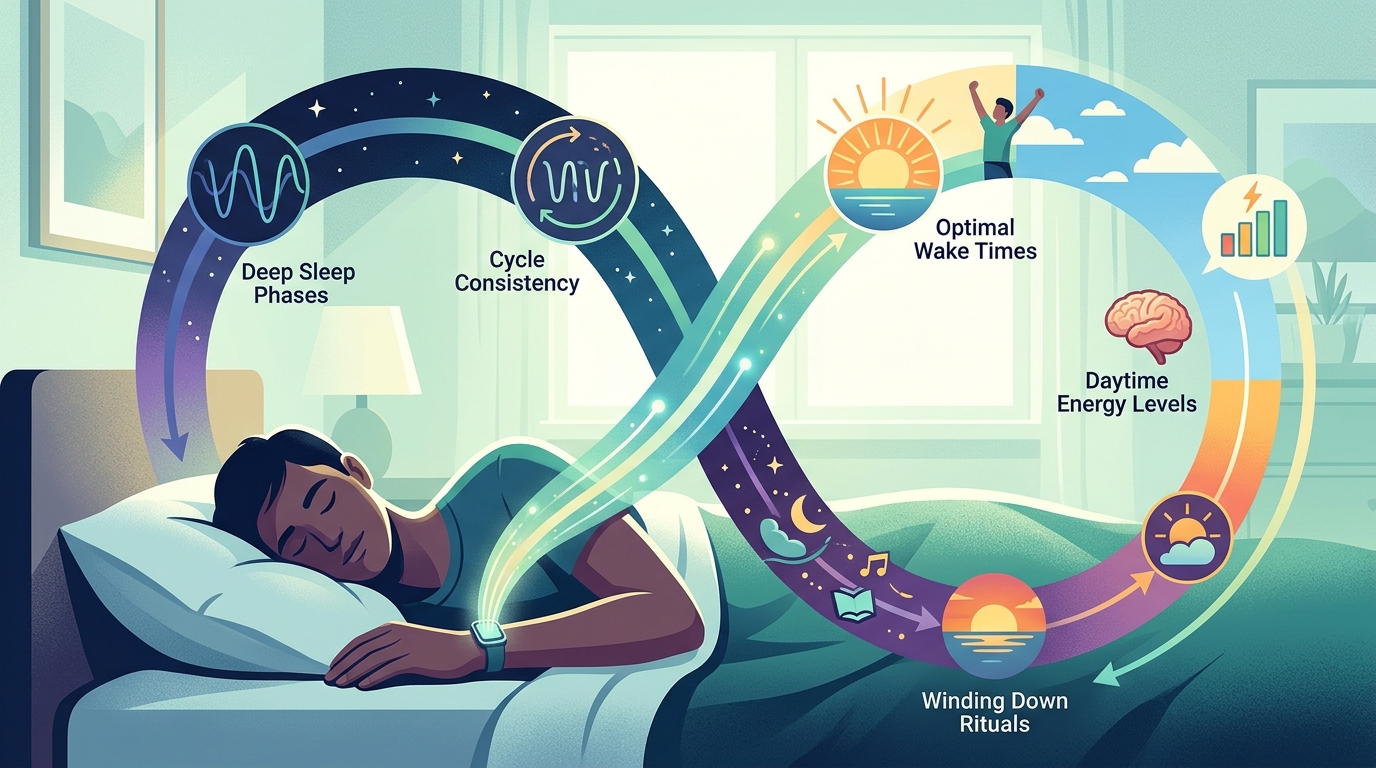
None of these measurements should be interpreted in isolation. A consistent schedule that provides too little sleep is not sufficient. A variable sleep-stage estimate is not proof of poor health. A late bedtime is not automatically a disorder, and a high sleep score is not a guarantee of restorative sleep.
A useful approach is to begin with the pattern that is both visible in your records and relevant to your daily life. If sleep is short, protect more time for it. If timing changes repeatedly, investigate the reasons and test a realistic routine. If daytime sleepiness persists despite adequate sleep opportunity, look beyond the wearable and consider professional assessment.
Then use a simple feedback loop: observe, interpret, make one reasonable change, and reassess. Keep the measurements that help you make decisions and ignore the details that add noise without changing what you do.
Your goal is not to produce a flawless sleep dashboard. It is to build a sleep schedule that supports adequate rest, workable daily timing, and reliable daytime functioning. A tracker can help you see the pattern. Understanding what the pattern means—and recognizing what the device cannot establish—is what turns the numbers into useful information.


Comments
Post a Comment