Orchestrating Your Personal Rest Space: Combining Smart Technologies for Enhanced Slumber
Smart tech integration for sleep is not about filling a bedroom with connected gadgets. It is about coordinating light, temperature, sound, schedules, and feedback so that the room becomes more compatible with the body's changing needs throughout the night. A smart bulb that dims at bedtime, a thermostat that follows a sensible overnight schedule, and a quiet environment can each contribute something useful. When these systems work together, their combined value comes from consistency rather than technological complexity.
The central challenge is orchestration. Individual devices may perform their assigned tasks correctly while still producing an uncomfortable overall experience. A motion sensor might turn on a bright light when someone gets up, an automated fan might become noisy during a quiet period, or a connected thermostat might override a carefully chosen temperature setting. Effective integration requires a clear understanding of what each device controls, when it should act, and when it should remain inactive.
Evidence-based sleep practices provide the foundation for this approach. Smart home technology can help make a supportive routine easier to maintain, but it cannot guarantee restorative sleep or compensate for every behavioral, environmental, or medical factor. The objective is to build a personal rest space that reduces unnecessary disruption while preserving comfort, control, and flexibility.
Start With Sleep Biology, Not the Number of Connected Devices
Human sleep is influenced by several interacting processes. The circadian system helps coordinate sleep and wake timing with the day-night cycle, while sleep pressure generally builds during waking hours and dissipates during sleep. Light exposure, environmental temperature, noise, stress, and daily habits can influence how these processes affect an individual.
This distinction matters when designing an automated bedroom. A device does not improve sleep simply because it is labeled smart. Its value depends on whether its behavior supports a relevant sleep habit or environmental condition.
For example, programmable lighting can help create a repeatable transition from daytime activity to an evening wind-down. A temperature controller can reduce the need to make repeated manual adjustments. A sound system can maintain a consistent acoustic environment when occasional outside noise is disruptive. These functions address different parts of the sleep experience, so they should be coordinated around a shared routine rather than operated as unrelated conveniences.
Consider the following decision logic:
- If late-evening brightness keeps the bedroom feeling like an active workspace, prioritize a gradual lighting transition before adding more devices.
- If the room becomes uncomfortably warm or cold overnight, examine temperature control and bedding before investing in sleep analytics.
- If intermittent noise is the main disturbance, investigate its source and consider appropriate sound management rather than automatically adding brighter lights or more aggressive climate settings.
- If the environment already feels comfortable but sleep remains consistently difficult, avoid assuming that additional automation is the answer. Consider sleep habits and whether professional evaluation may be appropriate.
The guiding principle is to identify a specific friction point first. Integration becomes useful when it addresses a real problem with the fewest unnecessary interventions.
What Official Sleep Guidance Can—and Cannot—Establish
Public health guidance from organizations such as the Centers for Disease Control and Prevention and the National Heart, Lung, and Blood Institute emphasizes regular sleep schedules, adequate sleep duration, a quiet and relaxing sleeping environment, and attention to factors that interfere with sleep. These principles provide a reasonable basis for planning a connected bedroom.
Light is especially important because its timing and intensity can influence circadian rhythms. Bright light at the wrong time may work against a desired sleep schedule, while an appropriately timed reduction in evening illumination can help establish a more distinct transition toward rest. However, lighting automation should not be confused with a treatment for a circadian rhythm disorder. Such conditions can require individualized assessment and carefully timed interventions.
Environmental comfort also matters, but there is no single bedroom temperature that works equally well for everyone. Thermal comfort depends on factors such as bedding, clothing, humidity, airflow, personal preference, and the conditions outside the room. A thermostat can regulate air temperature, but it cannot directly measure whether a particular person feels too warm under a thick duvet.
Noise management presents a similar distinction. Reducing disruptive sounds can make the environment more conducive to sleep, but a sound machine does not eliminate every source of disturbance. Masking noise may also be unsuitable for people who need to hear an alarm, a child, a medical alert, or another important signal.
These boundaries help separate established sleep principles from claims about specific products. Official guidance supports the general goals of regular timing and a suitable environment. It does not establish that a particular combination of connected bulbs, sensors, speakers, or wearable trackers will improve sleep for every user.
Design the Bedroom as a Coordinated System
A practical smart bedroom can be understood as a set of connected layers. Each layer serves a distinct purpose, but the system should follow a common schedule and avoid competing instructions.
The table highlights a useful design rule: give every system a defined responsibility. If two independent automations can change the same light or thermostat, the result may become unpredictable. Assigning a single primary controller to each function reduces conflicts and makes troubleshooting easier.
Compatibility deserves attention before complex routines are created. Devices may use different wireless protocols, supported integrations, or vendor-specific applications. A product that connects to a home network does not necessarily communicate with every other connected product. Check which actions and states are actually supported, and confirm whether essential routines continue working when internet access is interrupted.
Interoperability standards and shared home platforms can simplify coordination, but compatibility should be verified for the exact devices and features involved. The presence of a common connectivity label alone does not guarantee that every advanced automation is available.
Use Lighting to Establish a Predictable Daily Rhythm
Lighting is often a logical starting point because its timing can be programmed and its effects are immediately visible. Instead of treating the bedroom light as a simple on-off switch, think of illumination as a sequence that changes with the day's activities.
During the morning, appropriately timed light can help reinforce a regular wake schedule. During the evening, gradually reducing unnecessary brightness can make the bedroom feel less like a place for work and stimulation. Near bedtime, a low-level, comfortable setting can support reading or other quiet activities without requiring the room to become completely dark before a person is ready.
Smart bulbs, dimmers, and connected switches can implement these changes automatically. The important variable is not the number of colors available in an application. It is whether the chosen lighting schedule fits the user's actual sleep and wake times.
A person who works late shifts may need a different schedule from someone who wakes at sunrise. Automatically turning on bright lights at a conventional morning hour could be counterproductive for a shift worker who is trying to sleep during the day. Similarly, a gradual evening dimming routine should not prevent someone from using enough light to read safely, navigate stairs, or perform necessary tasks.
For a practical setup, begin with two reliable events: a wake-up lighting routine and an evening wind-down routine. Keep the transition gradual enough to be comfortable, and make sure a manual switch remains available. If the schedule regularly activates at the wrong time, correct the underlying schedule rather than adding extra sensors to compensate for it.
It is also important to distinguish visual comfort from a verified biological effect. Smart bulbs may offer different color temperatures, but selecting a warm-looking setting alone does not establish that the light exposure is harmless or that it will improve sleep. Intensity, timing, duration, and exposure from other screens and rooms also matter.
Coordinate Climate Control Without Chasing a Perfect Number
Temperature automation works best when it follows a comfort strategy rather than an arbitrary target. A connected thermostat may support scheduled heating or cooling, while a smart fan or compatible ventilation control may help manage airflow. These functions can be coordinated to avoid abrupt changes and reduce the need for repeated adjustments.
Start by identifying the conditions under which the room feels comfortable. If the bedroom is consistently warm at bedtime, cooling it before the planned sleep period may be more useful than waiting until the room becomes uncomfortable. If the room becomes cold later in the night, a modest scheduled adjustment may help, provided that the heating system supports it safely and efficiently.
There is a trade-off between comfort, energy use, and equipment behavior. Running a fan continuously may improve perceived airflow but add noise. Aggressive heating or cooling changes may consume more energy without improving comfort. Opening windows may provide useful ventilation in some settings but introduce outdoor noise, pollution, allergens, or security concerns in others.
Smart sensors can add context, but their measurements require interpretation. A sensor placed near a window, heating outlet, or sunlit surface may not represent the conditions near the bed. Humidity readings can also help explain why a room feels uncomfortable even when the displayed temperature appears reasonable.
Where possible, position sensors away from direct sunlight and concentrated airflow. Compare their readings with how the room actually feels before creating automatic responses. If a sensor repeatedly triggers unnecessary adjustments, simplify the routine or relocate the sensor rather than making the automation more complicated.
For people sharing a bedroom, climate automation should also account for different comfort preferences. A setting that works for one sleeper may not work for another. Bedding choices, individual airflow, and quiet manual adjustments may be more effective than repeatedly changing the entire room's temperature.
Manage Sound and Nighttime Movement With Restraint
Sound management should target the disturbance rather than add another layer of stimulation. A predictable low-level sound may help some people find intermittent environmental noise less noticeable, while others prefer silence. Neither approach is universally superior.
Connected speakers and sound machines can start a chosen sound at bedtime, lower its volume, and stop playback after a defined interval. These features become useful when they reduce repeated manual tasks without creating new problems. A stable volume setting is generally easier to evaluate than a system that continually changes sound levels in response to every detected noise.
Automatic responses to external sounds require particular caution. A microphone-based system might misinterpret conversation, traffic, a television, or an alarm. Increasing masking volume in response to an unexpected sound could make an important alert harder to hear. If the system cannot reliably distinguish ordinary noise from a safety signal, use a fixed, conservative sound setting instead of adaptive volume.
Nighttime lighting creates another coordination challenge. A motion sensor can activate a low-level path light when someone gets out of bed, but the response should not illuminate the entire room at full brightness. A brief delay before switching the light off can prevent repeated activation while someone moves slowly through the space.
However, motion sensing is not infallible. A sleeping person may be classified as absent, a pet may trigger a sensor, or a sensor may fail to detect a person who remains still. Essential safety lighting should not depend exclusively on a single motion sensor. Retain accessible manual controls and enough dependable illumination for safe movement.
Build Automations Around Events, Priorities, and Exceptions
The difference between a collection of connected products and an integrated sleep environment is the quality of the rules connecting them. An automation should define a trigger, an action, a timing condition, and an exception. Without these elements, a routine may behave correctly in one situation and become disruptive in another.
Consider an evening wind-down routine. A scheduled event could dim selected lights, lower entertainment volume, and prepare the bedroom for sleep. A separate climate routine could begin adjusting the temperature before the expected bedtime. These actions need not happen at exactly the same moment; they should occur when each function is most useful.
A well-designed routine might follow this sequence:
- Trigger: Use a scheduled wind-down time or a deliberate bedtime command.
- Check: Confirm that the household is in the expected nighttime mode and that the schedule is appropriate for the day.
- Act: Dim selected lights, set the chosen sound level, and apply the climate schedule.
- Protect: Preserve safety lighting, alarms, and manual overrides.
- Recover: Define what should happen after a connectivity failure or unexpected device restart.
One shared nighttime mode can reduce conflicting actions, but it should not become an inflexible command that overrides every other household activity. Someone may need to read, work late, care for another person, or enter the bedroom before the scheduled bedtime. A manual override or separate quiet mode allows the system to adapt without dismantling the routine.
Priorities should be explicit. Safety and user control come first, environmental comfort comes next, and convenience features come after those needs. If a routine must choose between making the room completely dark and preserving safe visibility for someone walking to the bathroom, the safety requirement should take precedence.
Automation also benefits from restraint. A bedroom that responds to every small change may become less predictable, not more. Start with a small number of dependable rules and add complexity only when a clear problem remains unsolved.
Use Sleep Tracking as Context, Not as a Verdict
Wearables, bedside sensors, and sleep applications can provide information about bedtime consistency, estimated sleep duration, nighttime movement, and other patterns. Some systems combine this information with room conditions to suggest adjustments. The potential benefit lies in helping a person notice relationships that would otherwise be difficult to remember.
For example, a sleep diary combined with bedroom temperature records might reveal that discomfort repeatedly occurs during a particular part of the night. A wearable might also help a user recognize that their sleep schedule varies substantially between workdays and weekends. These observations can guide a modest experiment, such as keeping wake time more consistent or changing a climate schedule.
Nevertheless, consumer sleep trackers estimate sleep using device-specific sensors and algorithms. Their results can differ from more comprehensive clinical assessments, particularly when estimating sleep stages or distinguishing quiet wakefulness from sleep. A numerical score should therefore not be treated as a definitive diagnosis or a complete measure of recovery.
Tracking can also become counterproductive when users feel compelled to optimize every score. Worrying about whether a device will report perfect sleep may increase bedtime anxiety and shift attention away from how the person actually feels during the day.
A more balanced method is to evaluate broad patterns over time. Consider sleep timing, perceived restfulness, daytime alertness, and relevant environmental conditions together. Change one variable at a time when possible, then allow enough comparable nights to determine whether the change appears useful. Avoid interpreting a single unusual night as proof that a particular device setting works or fails.
If tracking consistently creates anxiety, consider reducing how often results are reviewed or temporarily turning the feature off. If persistent sleep difficulties, loud snoring, breathing interruptions, or significant daytime sleepiness are present, consumer tracking should not delay appropriate medical evaluation.
Protect Privacy, Reliability, and Manual Control
A connected bedroom can contain sensitive information even when no camera is installed. Occupancy sensors, microphones, wearables, and sleep applications may reveal routines, periods of absence, nighttime movement, or inferred health-related patterns. Before enabling an integration, determine what information it collects, where it is processed, how long it is retained, and whether it is shared with other services.
Local processing may reduce dependence on cloud services for certain automations, but it does not automatically guarantee privacy. Review the permissions, account security, and data-handling practices of each relevant platform. Disable unnecessary microphone or location access, use strong account authentication, and avoid connecting a sleep system to services that have no clear role in the routine.
Reliability deserves equal attention. Cloud-dependent routines may stop working during an internet outage. A wireless sensor may lose its connection, a firmware update may change device behavior, or a battery-powered accessory may stop reporting data. The more essential the function, the less appropriate it is to depend entirely on a fragile chain of integrations.
Keep ordinary switches, alarm clocks, and essential lighting available where needed. Check that heating and cooling systems retain safe operating behavior if the automation hub fails. If a connected sound system provides a household alert, confirm that the alert remains audible under the chosen nighttime settings.
Accessibility should be considered from the beginning. Voice control can be helpful for some users, while others may prefer physical buttons or a simple wall switch. A routine should remain understandable and manageable for everyone who shares the room, including guests who do not know how the automation works.
Caution: Do not automate away essential safety functions.
Never assume that a connected sensor, sleep tracker, smart speaker, or automation hub can replace a required smoke or carbon monoxide alarm, a medical monitoring device, or another dedicated safety system. Do not let sleep routines silence essential alerts or disable required protections. If an automation affects heating equipment, electrical devices, or ventilation, use supported controls and follow the equipment manufacturer's safety instructions. Test fallback behavior before relying on a routine overnight.
A Practical Checklist for a More Coherent Sleep Environment
Before adding more devices, work through the following checklist. The purpose is to make the environment simpler and more consistent, not to create a bedroom that requires constant technical supervision.
- Identify the main source of disruption: light, temperature, noise, inconsistent timing, or another specific factor.
- Establish a realistic bedtime and wake-time schedule that reflects work, family, and personal obligations.
- Program a gentle evening lighting transition and a convenient wake-up routine where appropriate.
- Set climate controls around observed comfort rather than assuming a universal ideal temperature.
- Choose a sound strategy that does not interfere with important alarms or household responsibilities.
- Limit motion-triggered lighting to the areas and brightness levels needed for safe nighttime movement.
- Confirm that devices can communicate through the intended platform and that required features are supported.
- Assign one primary controller to each shared function to avoid competing schedules.
- Keep physical controls and dependable fallback options available for essential functions.
- Review microphone, occupancy, wearable, and sleep-application privacy settings.
- Test the routine during normal household activity before relying on it overnight.
- Track a few meaningful outcomes, such as schedule consistency and daytime alertness, instead of pursuing every available metric.
After the basic setup is stable, change only one or two elements at a time. If the room becomes more comfortable and the routine easier to maintain, additional hardware may be unnecessary. If the system creates more alerts, adjustments, or troubleshooting than it eliminates, simplify it.
Frequently Asked Questions
1. What does smart tech integration for sleep actually mean?
It means coordinating connected devices so that their schedules and actions support a consistent sleeping environment. Rather than operating lighting, climate controls, sound devices, and sensors independently, an integrated system uses shared routines, clear priorities, and appropriate exceptions. The goal is better environmental consistency, not maximum automation.
2. Do smart home devices directly improve sleep quality?
They may help indirectly by making useful habits easier to maintain or by reducing environmental disruptions. For example, scheduled lighting can support a predictable evening routine, and climate automation can reduce repeated manual adjustments. However, device connectivity alone does not establish a sleep benefit, and individual outcomes depend on the underlying problem, implementation, and personal circumstances.
3. Should all bedroom devices run through one application?
Not necessarily. A common platform can make routines easier to coordinate, but the most important requirements are reliable interoperability, understandable controls, and safe fallback behavior. If a single application introduces unnecessary complexity or makes essential functions dependent on an unreliable cloud connection, simpler independent controls may be preferable.
4. What is the best temperature for a smart bedroom?
There is no universally optimal setting for every sleeper and bedroom. Personal comfort depends on humidity, bedding, clothing, airflow, and individual preferences, among other factors. Begin with a comfortable baseline, observe how conditions change overnight, and make small adjustments. Avoid assuming that a specific temperature reading proves that sleep conditions are ideal.
5. Are sleep trackers accurate enough to control the entire bedroom?
Sleep trackers can provide useful estimates and help identify patterns, but they do not perfectly measure every aspect of sleep. Their readings may be affected by device design, algorithms, and individual behavior. Using them as the sole authority for lighting, temperature, or sound changes can introduce unnecessary fluctuations. It is generally more sensible to combine trend information with direct observations and personal comfort.
6. Can automation work for people with irregular schedules?
Yes, but fixed clock-based routines may not be suitable when bedtime changes frequently. Consider a manually activated bedtime mode, a schedule that varies by day, or a routine that can be adjusted before a shift begins. Avoid using a motion or occupancy sensor as the only indication that someone is ready for sleep. The control method should match the actual routine rather than force the person into a conventional schedule.
7. What should happen if the internet goes down?
Essential environmental and safety functions should remain manageable without relying entirely on internet access. Where supported, use local schedules or direct device controls for routine actions. Retain physical switches and dependable alarms, and test which automations continue working during a network interruption. Do not assume that a device's ordinary features and its cloud-based integrations share the same outage behavior.
8. How can someone tell whether a new automation is helping?
Define a specific outcome before changing the system. If the problem is a bedroom that stays too warm, evaluate comfort and the need for nighttime adjustments. If the problem is inconsistent bedtime lighting, assess whether the transition becomes easier to follow. Keep other conditions reasonably stable and review patterns across multiple nights. If the change creates no meaningful improvement, revert it or test a simpler alternative.
9. Is a fully automated bedroom better than a minimally connected one?
No. A small system that reliably controls the most disruptive environmental factors may be more useful than a large network of devices with overlapping responsibilities. People who enjoy technology and have predictable routines may benefit from additional integrations. Those who prefer simplicity, have irregular schedules, or become anxious about tracking may be better served by a few dependable controls and fewer notifications.
Conclusion: Optimize for Consistency, Not Complexity
A well-orchestrated sleep environment begins with a specific understanding of what makes rest difficult. Light, temperature, sound, daily timing, and environmental interruptions each present different challenges, so they should not be addressed through one indiscriminate automation strategy. Official sleep guidance provides a foundation of consistent schedules and a quiet, relaxing environment; connected technology can help translate those principles into repeatable daily actions.
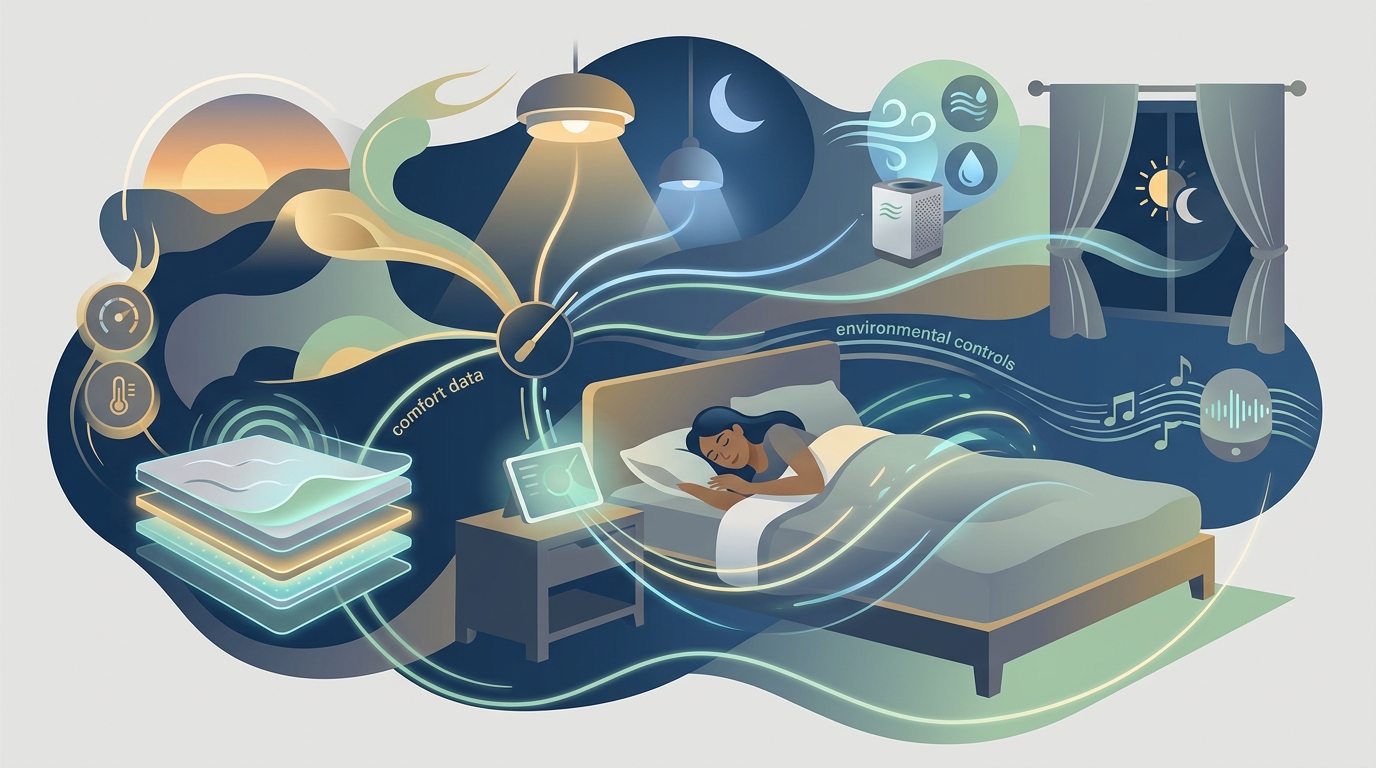
The strongest system is one in which each device has a clear responsibility, schedules complement one another, and safety and manual control remain intact. Lighting can mark the transition from activity to rest. Climate controls can maintain a comfortable range. Sound management can reduce selected disturbances without obscuring essential alerts. Sensors and sleep trackers can contribute context, provided their limitations are understood and their outputs are not mistaken for definitive health assessments.
Integration should also remain responsive to individual circumstances. A shift worker, a household with different temperature preferences, and a person who experiences anxiety from sleep tracking need different solutions. When a routine fails to improve the original problem, the appropriate response may be to revise it, simplify it, or abandon it—not to add another device.
Begin with one meaningful improvement, establish a dependable routine, and evaluate whether it makes the bedroom more comfortable and the sleep schedule easier to maintain. Add further coordination only when evidence from everyday experience suggests that it is worthwhile. The ultimate measure of smart tech integration for sleep is not how many devices communicate with one another, but whether the resulting environment supports a calmer, safer, and more sustainable approach to rest.


Comments
Post a Comment