Are you misinterpreting your sleep tracker data? What key metrics actually reveal about your sleep.
Are you really sleeping badly—or are you reading the wrong number? Sleep tracker data interpretation becomes much more useful when a nightly score stops being treated as a verdict and starts being treated as a set of physiological clues. A wearable can estimate sleep duration, timing, sleep latency, heart rate, heart rate variability, and stages such as REM and deep sleep. But those numbers do not all have the same scientific meaning, and they are not measured with the same degree of certainty.
The central idea is simple: the most actionable sleep data usually comes from patterns across nights, not from trying to maximize one attractive-looking percentage. That distinction matters because consumer wearables infer sleep stages from signals such as movement and cardiovascular measurements, whereas clinical polysomnography uses brain, eye, muscle, cardiac, and other physiological signals to classify sleep. Recent evidence continues to show that wearables can be useful for longitudinal tracking while remaining imperfect substitutes for laboratory sleep measurement.
What does your sleep tracker actually know?
A sleep tracker is not looking directly into your brain and labeling every 30-second interval as REM, N2, or N3. Instead, different devices combine sensors and algorithms to infer states from signals such as movement, pulse, pulse-wave features, skin temperature, and sometimes oxygen-related measures. The exact sensor combination and algorithm differ by device.
That creates an important distinction between measurement and inference. Heart rate may be measured reasonably directly from an optical or electrical signal, while “deep sleep” is an algorithmic classification built from indirect evidence. The latter can be useful without being identical to the physiological definition used in a sleep laboratory.
Polysomnography classifies sleep architecture using signals that include electroencephalography, electrooculography, and electromyography. In conventional scoring, NREM sleep is divided into N1, N2, and N3, while REM is a separate stage. The brain activity that defines these stages is not directly available to a typical consumer wrist wearable.
Why can “deep sleep” be misleading?
Deep sleep usually refers to N3, the slow-wave stage of NREM sleep. It is characterized in laboratory recordings by prominent slow, high-amplitude brain waves. N3 is not evenly distributed throughout the night. It tends to be concentrated earlier, while REM periods generally become longer toward morning.
That timing creates an easy-to-miss counterexample. Suppose someone normally sleeps from 11:00 p.m. to 7:00 a.m. and then cuts the night short to 5:30 a.m. Their tracker may still show a respectable amount of deep sleep because much of N3 occurs earlier in the sleep episode. But the shortened night may remove a larger portion of later REM-rich sleep.
The reverse can also happen. A person who sleeps longer after accumulated sleep loss may see an unusual stage distribution without that meaning the longer night was harmful. Sleep architecture changes with age, prior sleep, illness, stress, and other factors. There is therefore no universal “deep sleep percentage” that everyone should attempt to hit every night.
Research on REM sleep also does not support the simplistic idea that more REM is automatically better. REM is physiologically distinctive and has been associated with several proposed functions, including memory-related processes, but the precise functions and optimal quantity are still active areas of research.
So what does REM sleep duration actually reveal?
REM sleep is a real physiological state, not just a wellness-app category. During REM, brain activity has distinctive characteristics, muscle tone is markedly reduced, and eye movements are prominent. Across a normal night, REM periods tend to lengthen as the night progresses.
For tracker interpretation, the important question is therefore not simply “Did I get enough REM?” A better question is “Has my estimated REM pattern changed consistently, and does that change line up with changes in sleep duration, timing, or how I function during the day?”
If your total sleep time suddenly falls from eight hours to five and a half, a reduction in estimated REM deserves a different interpretation from a similar reduction occurring while total sleep time remains stable. If the device reports less REM for one night after travel, an unusually early alarm, or fragmented sleep, that is a contextual clue rather than a diagnosis.
If X happens—such as a repeated reduction in total sleep plus a repeated shift in REM timing—look for the broader sleep pattern first. If total sleep and daytime functioning remain stable and only the stage estimate fluctuates, consider the possibility that algorithmic variability is contributing to the apparent change.
Is sleep latency a better metric?
Sleep latency is the estimated time it takes to transition from wakefulness into sleep. It can be genuinely useful because difficulty initiating sleep is part of the broader picture of sleep continuity. But a tracker generally does not observe the exact moment consciousness changes. Movement-based systems can classify quiet wakefulness as sleep, which makes the reported latency an estimate.
This matters most when you are interpreting small differences. A reported latency of 11 minutes one night and 17 minutes the next does not necessarily mean your brain took exactly six additional minutes to enter sleep. The useful signal is often whether latency is repeatedly elevated and whether it corresponds with your own experience of lying awake.
Here is a useful conditional approach: if the tracker reports long sleep latency and you remember being awake for a long time, treat that convergence as meaningful behavioral information. If the tracker reports long latency while you consistently remember falling asleep quickly, investigate the device's assumptions and the pattern across several nights before changing your routine.
What does sleep efficiency tell you that total sleep time misses?
Sleep efficiency describes the proportion of a sleep opportunity that is spent asleep. It incorporates sleep initiation and maintenance rather than simply counting hours between bedtime and wake time.
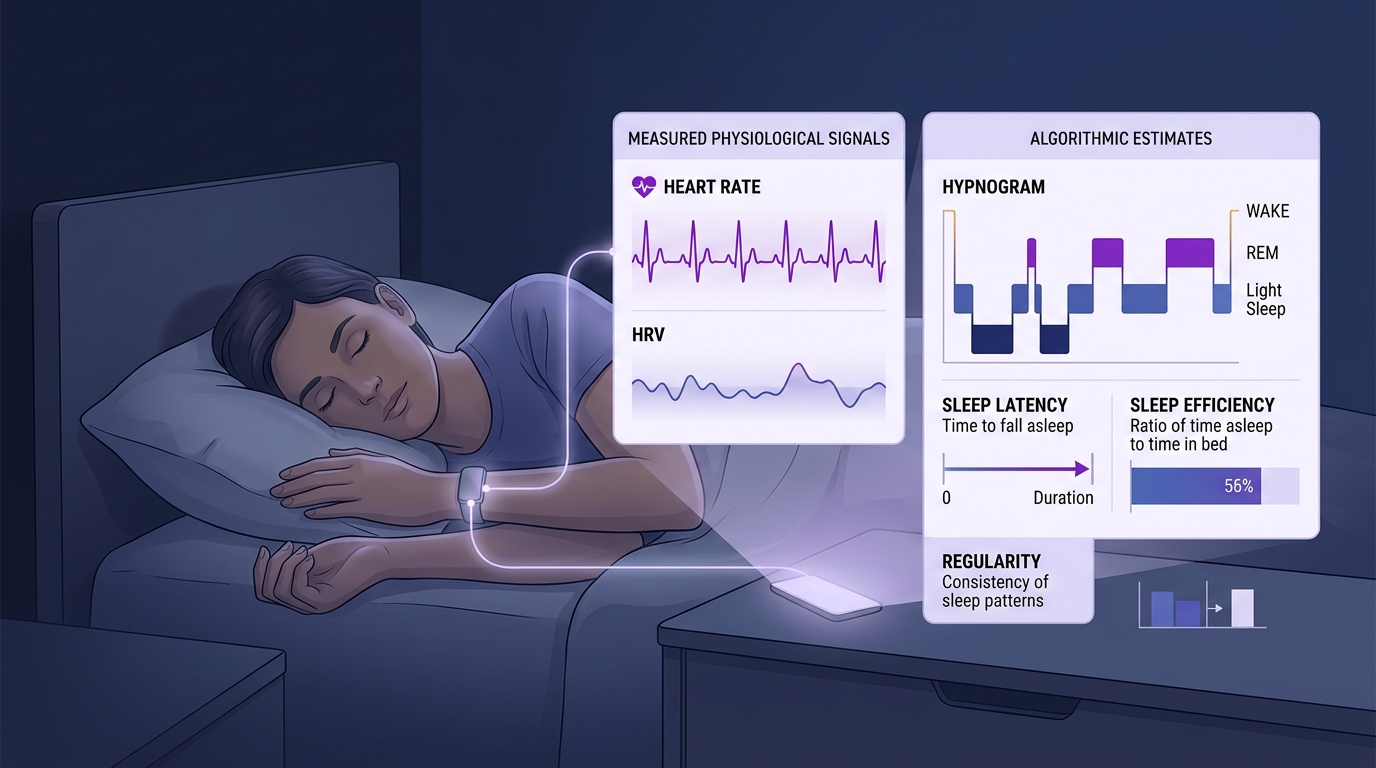
Imagine two nights with the same eight-hour time in bed. On Night A, you fall asleep quickly and remain asleep with brief interruptions. On Night B, you spend 45 minutes awake before sleep and another 45 minutes awake during the night. Total time in bed is identical, but sleep continuity is not.
This is why sleep efficiency, sleep latency, wake after sleep onset, and the number or duration of awakenings should be interpreted together. A single “sleep score” can hide these differences by compressing several dimensions into one number.
Why is sleep HRV useful—and why is it easy to overread?
Heart rate variability, or HRV, describes variation in the time intervals between successive heartbeats. It is influenced by the autonomic nervous system, and its behavior changes across sleep states. During sleep, cardiovascular and brain systems interact dynamically, so nocturnal HRV is not simply a passive “recovery score.”
A higher or lower HRV value can be influenced by many variables, including recent exercise, alcohol, illness, stress, sleep timing, breathing, medications, measurement method, and normal individual variation. Even the choice of HRV metric matters. A device may report a particular time-domain measure while another system reports something calculated differently.
For that reason, sleep HRV is most informative when treated as a personal longitudinal signal. If your usual overnight HRV is relatively stable and then changes sharply for several nights alongside shorter sleep, higher resting heart rate, or obvious disruption, the combination deserves attention. If HRV changes on one night while everything else looks normal, it is usually premature to attach a physiological story to that isolated value.
Could your tracker be right about sleep while you still feel awful?
Yes. This is one of the most important exceptions in sleep tracker data interpretation.
A tracker can estimate eight hours of sleep while missing a meaningful aspect of the experience. Sleep health is multidimensional: duration, continuity, timing, regularity, daytime functioning, and other dimensions all contribute to the broader picture. A numerical score cannot fully represent how alert, restored, or cognitively effective you are during the day.
The opposite can happen too. You can feel tired after a night that looks excellent on the app. Subjective sleep quality and objective measurements are related but not interchangeable. A person may notice stress, pain, environmental disturbance, or unusual sleep timing that a device does not capture well.
This is why a simple sleep diary can remain surprisingly valuable. Record bedtime, approximate sleep onset, wake time, major awakenings, naps, unusual stressors, exercise, alcohol or caffeine, and how you felt the next day. A sleep diary does not replace physiological measurement; it adds context that sensors cannot directly provide.
What does sleep regularity reveal about your circadian rhythm?
Regularity is different from timing. Timing asks when you sleep. Regularity asks how consistently that pattern occurs across days. Someone can have a relatively late but stable sleep schedule, while another person can alternate dramatically between early and late bedtimes.
This distinction matters because the circadian system coordinates many biological processes on approximately 24-hour cycles. Light exposure, eating, activity, work schedules, and sleep timing all interact with that system. Research increasingly treats regularity as a meaningful dimension of sleep health, although important questions about causality and the best way to measure regularity remain unresolved.
For optimization, do not start by asking the tracker for the “perfect bedtime.” First inspect the variability of your actual schedule. If your wake time swings by several hours between workdays and weekends, that pattern may be more informative than whether a single night contains 19% or 23% estimated deep sleep.
If your goal is to stabilize your circadian rhythm, first look for repeated timing anchors, especially the consistency of waking. If your schedule is constrained by shift work, caregiving, travel, or other obligations, do not interpret irregularity as a personal failure; the relevant question becomes how much consistency is realistically achievable under those conditions.
What if two trackers disagree?
Disagreement does not automatically mean one device is broken. Different devices may use different sensors, sampling approaches, definitions, algorithms, and smoothing procedures. Even when two devices are both technically functioning, they can produce different estimates from the same night.
This is particularly important for stage estimates. Recent systematic evidence comparing wearable devices with polysomnography has found variability across devices and metrics. Some global measures can be reasonably useful for longitudinal monitoring, while detailed classification of light, deep, and REM sleep remains less dependable.
A useful counterexample is a change in device rather than a change in physiology. Suppose Tracker A reports 80 minutes of deep sleep and Tracker B reports 105 minutes after you switch devices. If your bedtime, wake time, total sleep, daytime alertness, and other conditions have not changed, the 25-minute difference should not be interpreted automatically as a sudden biological improvement.
When comparing devices, prioritize consistency within the same device over comparing raw numbers between different algorithms. If the purpose is to understand your own trend, changing measurement systems repeatedly can create artificial discontinuities in the data.
How should you turn tracker numbers into useful decisions?
The strongest workflow is not “see score, make change.” It is “observe pattern, identify context, test one plausible explanation, then reassess.” This reduces the temptation to chase every nightly fluctuation.
A practical interpretation sequence
- Start with duration. Ask whether you are consistently allowing enough time for sleep rather than trying to compensate for insufficient sleep with a higher score.
- Check timing. Look at when sleep starts and ends, not just how long it lasts.
- Check regularity. Compare workdays with free days and examine variability over at least several nights.
- Check continuity. Review latency, awakenings, and wake after sleep onset together.
- Check stage estimates last. Use REM and deep-sleep numbers as contextual signals rather than primary optimization targets.
- Compare with daytime function. Ask whether alertness, concentration, mood, and physical performance changed in the same direction.
- Look for repeated convergence. The most persuasive personal signal is a change that appears across multiple metrics and multiple nights.
Practical action checklist
- □ Review at least one to two weeks before drawing conclusions from a new pattern.
- □ Record actual bedtime and wake time alongside tracker estimates.
- □ Keep a simple sleep diary when the wearable result conflicts with your experience.
- □ Track sleep duration separately from sleep-stage percentages.
- □ Examine sleep latency together with remembered time awake.
- □ Treat HRV as a personal trend rather than a universal target.
- □ Look at sleep timing and regularity when circadian rhythm is the goal.
- □ Avoid changing several sleep variables at once if you want to learn what actually helped.
- □ Keep the same measurement system when possible if the goal is longitudinal comparison.
- □ Seek professional assessment when symptoms persist despite reassuring tracker scores.
Simple environmental tools can also become useful context rather than “optimization gadgets.” For example, a bedside clock can provide an independent reference for wake time, blackout curtains or a sleep mask can help describe the light environment, and a white-noise machine or earplugs can help document whether nighttime noise is part of the story. The point is not to collect more devices. It is to make the data easier to interpret.
Can you improve deep sleep by chasing the deep-sleep number?
Usually, that is the wrong optimization target. Deep sleep is part of normal architecture, and its amount changes with age, sleep pressure, timing, and other conditions. Trying to force a tracker percentage upward can lead to an undesirable feedback loop: you make repeated changes to bedtime, supplements, exercise, temperature, or other variables simply because an algorithm reports a lower number.
A better question is whether the conditions supporting consolidated sleep are improving. If total sleep opportunity is short, increasing the opportunity for sleep is logically more fundamental than trying to manipulate a stage percentage. If sleep timing is highly irregular, stabilizing the schedule may be more relevant to circadian alignment than pursuing a specific N3 target.
This is a general principle of human performance tracking: optimize the biological process you understand, not merely the metric that looks most precise. A decimal-heavy dashboard can create false confidence.
What does the research say about wearables versus polysomnography?
Polysomnography remains the reference method for detailed sleep architecture because it directly records physiological signals used to define sleep stages. It is also more burdensome and less convenient for repeated everyday monitoring.
The recent evidence creates a useful middle ground. Wearables are not worthless because they are imperfect, and they are not equivalent to a sleep laboratory because they produce detailed graphs. A 2026 systematic review and meta-analysis found that wearable devices can provide reasonable estimates of broad sleep metrics and may complement longer-term monitoring, while performance varied across devices and detailed sleep-stage characterization remained limited.
That distinction explains why a wearable can still be valuable for behavior change. If it consistently shows that your sleep opportunity has fallen, your schedule has become more irregular, or your estimated awakenings rise during a stressful period, those patterns can prompt useful questions. They simply should not be mistaken for definitive clinical measurements.
What should you do when the app gives you a bad score?
First, do not let the score create the problem it claims to measure. Anxiety about a poor sleep score can itself make the following night feel more consequential.
Instead, inspect the components. Did total sleep fall? Did bedtime move substantially? Was there more wakefulness? Did your subjective sleep quality change? Did HRV shift at the same time as resting heart rate or other contextual factors? Did the previous day include unusual exercise, alcohol, illness, travel, or stress?
If the answer is “only the score changed,” there may be little reason to act. If several independent pieces of information moved together for multiple nights, there is more useful information to investigate.
Frequently asked questions about sleep tracker data interpretation
Is 20% deep sleep a good target?
There is no universal percentage that every healthy adult should achieve every night. Deep sleep varies with age, prior sleep, timing, and individual physiology. Treat the device's deep-sleep estimate as a trend rather than a fixed performance target.
Is more REM sleep always better?
No. REM is biologically important, but more is not automatically better. REM normally becomes more prominent later in the night, so total sleep duration and the timing of the sleep episode can strongly influence the amount observed.
Why does my tracker say I was asleep when I remember being awake?
Consumer trackers infer sleep partly from movement and other indirect signals. Quiet wakefulness can therefore be classified as sleep. If this mismatch happens repeatedly, compare the tracker with a sleep diary and consider the pattern of wake after sleep onset rather than focusing on one timestamp.
Should I trust sleep latency from a wearable?
Use it as an estimate. Research shows that wearable estimates of sleep onset can differ from polysomnography and vary according to device and person. It becomes more informative when the estimate agrees with your own experience across multiple nights.
Is nighttime HRV a reliable recovery score?
HRV reflects autonomic regulation and changes naturally across sleep. It can be useful as a longitudinal personal signal, but a single HRV value cannot summarize recovery by itself. Measurement method, breathing, illness, stress, exercise, and other factors can influence it.
Should I prioritize sleep duration or sleep-stage percentages?
Start with adequate sleep opportunity and a sustainable schedule. Duration, timing, regularity, continuity, daytime functioning, and architecture all contribute to sleep health, so stage percentages should not replace the broader picture.
How many nights should I analyze?
There is no universal magic number for personal tracking, but one night is usually a weak basis for interpretation. Multi-night patterns are more informative because sleep naturally varies. Longer observation is especially important when assessing regularity.
Can a good tracker score rule out a sleep disorder?
No. A reassuring consumer score does not rule out a sleep disorder. Persistent symptoms should be evaluated on their own merits, particularly when breathing disturbances, excessive daytime sleepiness, or chronic difficulty initiating or maintaining sleep are present.
The bigger lesson: interpret the system, not the score
The most useful sleep tracker is not necessarily the one that produces the most elaborate dashboard. The more important skill is knowing what each metric represents, what it cannot represent, and how several measurements fit together.
Deep sleep and REM are components of a changing biological architecture. Sleep latency is an estimate of the transition into sleep. Sleep efficiency describes continuity. HRV offers a window into autonomic regulation but is sensitive to context. Sleep regularity reveals how stable your timing and duration are across days. Total sleep time provides a foundational quantity, but it does not describe every dimension of healthy sleep.
The practical hierarchy is therefore straightforward: look first at duration and timing, then continuity and regularity, then use stage and physiological estimates to add context. If several signals move together, investigate the shared context. If only one algorithmic metric moves, hold the interpretation loosely.
That approach also protects against a common paradox of sleep technology: measuring more can sometimes make sleep feel less understandable. The goal is not to obey the dashboard. It is to use repeated measurements to ask better questions about your biology, your schedule, your environment, and your daytime performance.
In other words, sleep tracker data becomes genuinely valuable when it stops being a nightly grade and becomes a longitudinal experiment. You are not trying to manufacture a perfect graph. You are trying to recognize stable patterns, distinguish physiological signals from algorithmic estimates, and make changes only when the evidence points in a coherent direction.


Comments
Post a Comment