Are You Misinterpreting Your Sleep Tracker's Data?
Your sleep tracker reports seven hours of sleep, a promising recovery score, and a seemingly perfect distribution of REM and deep sleep. Yet you wake up exhausted. Or perhaps the opposite happens: your device assigns you a disappointing score, but you feel alert, focused, and ready for the day. Which signal should you trust? Understanding sleep tracker data interpretation starts with recognizing that a wearable's measurements are estimates of sleep, not a complete assessment of how your brain and body recovered overnight.
Consumer sleep monitoring devices can help reveal patterns in bedtime, wake time, sleep duration, and nighttime interruptions. They can also make sleep habits easier to connect with exercise, light exposure, caffeine, stress, and daily energy. The problem begins when estimated REM percentages, deep sleep minutes, or proprietary sleep scores are treated as precise biological measurements. A useful tracker supports better decisions; it does not automatically explain why you feel tired or establish whether your sleep is healthy.
The most reliable approach combines the device's measurements with established sleep science, your daytime functioning, and the limitations of wearable technology. This distinction matters whether you use a smartwatch, a fitness band, a bedside sensor, or sleep analysis software to improve your circadian rhythm.
What Your Sleep Tracker Actually Measures
Most consumer wearables do not directly observe the electrical activity of your brain. Instead, they collect signals associated with sleep and use algorithms to estimate when you are asleep, awake, or in different sleep stages.
Depending on the device, these signals may include:
- Movement: Accelerometers detect wrist or body motion. Extended periods of stillness may suggest sleep, while movement may suggest wakefulness.
- Heart rate: Optical sensors estimate changes in pulse that can accompany different sleep stages, exercise recovery, stress, and illness.
- Heart rate variability: Some devices analyze variations in the time between heartbeats as one indicator of autonomic nervous system activity.
- Breathing patterns: Certain wearables estimate respiratory rate or related signals, although available measurements vary considerably by product.
- Skin temperature and blood oxygen: Some devices track overnight changes that may provide additional context but are not definitive measures of sleep quality.
Software combines these inputs to classify periods of the night. The resulting timeline is an algorithmic estimate, not a direct recording of brain waves. Two devices can process similar signals differently and report different results for the same night.
This does not make wearable data useless. It changes the question you should ask. Rather than asking whether every reported stage is correct, ask whether the device consistently identifies meaningful patterns that help you understand your sleep behavior.
Why Official Sleep Research Matters More Than a Perfect Score
Clinical sleep research provides an important reference point for interpreting consumer data. The American Academy of Sleep Medicine identifies polysomnography as the standard diagnostic test for many sleep disorders. A conventional sleep study records multiple physiological signals, including brain activity, eye movements, and muscle activity. Depending on the study, it may also record breathing, oxygen levels, heart rhythm, and leg movements.
These signals help clinicians distinguish sleep stages and identify conditions that a consumer tracker cannot reliably diagnose. For example, a laboratory can use electroencephalography, or EEG, to assess patterns of brain activity associated with different stages of sleep. A wrist-worn device generally infers those stages from indirect signals.
The National Institutes of Health also describes sleep as a process involving recurring stages with distinct physiological characteristics. Non-rapid eye movement sleep includes lighter stages and slow-wave deep sleep, while rapid eye movement sleep is associated with vivid dreaming and characteristic changes in brain activity, muscle tone, and eye movements.
These established findings explain why stage estimates can be informative while still being imperfect. The biological stages are real, but a consumer algorithm's ability to classify them depends on the device, its sensors, the population studied, and the conditions under which it operates.
What the evidence supports: Consumer devices can be useful for monitoring sleep timing and identifying broad patterns. Their estimates of individual sleep stages are less dependable than measurements obtained through appropriately conducted clinical testing. Accuracy varies across devices and metrics, so one validation study should not be assumed to describe every model or software update.
The practical implication is straightforward: use consumer sleep data to formulate questions about your habits, not to replace a clinical assessment when symptoms suggest a sleep disorder.
REM Sleep and Deep Sleep: What the Percentages Really Mean
Sleep-stage charts often receive more attention than total sleep duration or sleep timing because their colorful segments appear precise. However, a stage percentage is only as reliable as the method used to estimate it.
REM sleep
REM sleep is involved in several important processes, including aspects of memory, learning, and emotional processing. It commonly becomes more prominent during the latter portion of a typical night's sleep. This is one reason that consistently cutting sleep short in the early morning can reduce the opportunity to obtain later REM periods.
A tracker may estimate REM sleep using combinations of movement, heart rate, and other physiological signals. But it cannot reliably establish the exact amount of REM sleep from those signals alone in every person.
If your REM percentage changes sharply from one night to the next, do not immediately conclude that your memory consolidation or emotional recovery has deteriorated. Consider whether you slept for less time, changed your schedule, consumed alcohol, experienced unusual stress, or used a different device or algorithm.
Deep sleep
Deep sleep, also called slow-wave sleep, is a stage of non-REM sleep characterized by slow brain-wave activity. It is associated with restorative physiological processes and can be particularly prominent during the earlier part of the night.
Its duration varies with age, sleep history, individual biology, and other factors. A lower estimated amount on a single night does not automatically indicate a problem. Nor does a high deep-sleep reading prove that every aspect of recovery was optimal.
Wearables may confuse quiet wakefulness with sleep or assign periods to the wrong stage. They may also report different stage distributions because their classification algorithms use different inputs and definitions.
How to interpret a percentage without overreacting
Suppose your device reports that REM sleep fell from 22% to 15% overnight. Those numbers alone do not establish that you experienced a clinically meaningful loss of REM sleep. First, check total sleep time. A shorter night can alter both the minutes available for each stage and the apparent percentage distribution.
Next, look at the broader pattern. If the reading repeatedly changes while your schedule and daytime functioning remain stable, the algorithm or ordinary night-to-night variation may explain some of the difference. If persistent fatigue, frequent awakenings, or other symptoms accompany the change, investigate those symptoms rather than attempting to correct the percentage itself.
The goal is not to force every night into an idealized stage distribution. It is to create conditions that support adequate, regular sleep and to identify persistent problems that deserve attention.
Sleep Scores Are Summaries, Not Medical Grades
A sleep score usually combines several inputs into a single number. Depending on the manufacturer, those inputs may include sleep duration, estimated stage distribution, time awake, bedtime consistency, and physiological measurements.
The convenience is obvious: a single score makes it easy to compare nights. The limitation is equally important: a score can conceal the difference between well-supported measurements and uncertain estimates.
Imagine two nights with similar scores. On the first night, you sleep long enough, wake at your usual time, and feel refreshed. On the second, the device detects a favorable stage distribution but records substantially less sleep than you intended. If the algorithm gives both nights similar ratings, the score does not adequately communicate the practical difference between them.
Scores are also not standardized across manufacturers. One device's 85 may not mean the same thing as another device's 85. Some scoring systems reward consistency, while others place different weights on duration or estimated stages. Without knowing the formula and validation evidence, the number should not be treated as a universal measure of health.
A better decision rule: If your score falls but sleep duration, timing, and daytime alertness remain stable, review the underlying metrics before changing your routine. If your score remains high while you regularly feel exhausted, prioritize your symptoms and investigate possible causes instead of trusting the headline number.
How Accurate Are Consumer Sleep Trackers?
Accuracy is not a single property. A device can perform reasonably well at estimating total sleep time while being less accurate at identifying wakefulness or distinguishing REM from deep sleep.
One recurring challenge is that many devices infer sleep partly from inactivity. A person lying still while awake may be classified as asleep. Conversely, movement during sleep can sometimes be interpreted as wakefulness. Heart rate and breathing patterns add useful context, but they are affected by many processes unrelated to sleep stages.
Clinical validation studies commonly compare wearable estimates against polysomnography. Researchers may evaluate whether a device identifies sleep and wake periods correctly, how well its stage classifications agree with clinical scoring, and whether it systematically overestimates or underestimates particular measures.
When interpreting validation findings, look for several details:
- The exact model: Results for one generation should not automatically be applied to another.
- The metric tested: Agreement on total sleep time does not prove accurate REM classification.
- The participants: A study involving healthy adults may not represent people with insomnia, sleep apnea, irregular schedules, or other conditions.
- The testing environment: Results obtained in a laboratory may differ from performance during ordinary home use.
- The comparison method: Agreement with a clinical reference is more informative than a manufacturer's claim that an algorithm is advanced.
Even when average performance looks good, individual errors can still matter. A device that performs well across a group may misclassify a particular person's sleep. This is especially important when someone tries to infer a diagnosis from a series of app-generated charts.
For personal optimization, consistency can be more useful than absolute precision. If the same device repeatedly shows that your bedtime shifts later on weekends, it may reveal a meaningful habit even if its sleep-stage estimates are imperfect. However, a consistent measurement is not automatically accurate, so major health decisions should not depend on wearable estimates alone.
Read the Metrics in the Right Order
When reviewing your sleep dashboard, start with the measurements that are generally easier to connect to everyday behavior. Then consider the more uncertain metrics as supporting context.
This order helps prevent a common mistake: trying to optimize a metric simply because it is visible. Adequate sleep opportunity and a sustainable schedule usually offer more actionable starting points than attempting to increase a specific stage by a few percentage points.
Use Sleep Data to Understand Your Circadian Rhythm
Your circadian rhythm is the internal timing system that coordinates daily patterns in sleep propensity, alertness, hormone secretion, and other physiological processes. It is influenced by the brain's central circadian clock and by environmental time cues, especially light.
A sleep tracker can help reveal whether your actual routine aligns with your intended schedule. For example, consistently falling asleep much later on weekends may indicate a shift in timing that makes early weekday mornings more difficult.
But a wearable cannot fully determine your circadian phase from bedtime alone. Going to bed at 10:30 p.m. does not prove that your internal clock is aligned with that time. Individual chronotypes, light exposure, work demands, and sleep pressure all influence when sleep occurs.
To use tracking data more intelligently, connect timing measurements with real-world behavior:
- Record when you go to bed, when you get up, and how rested you feel.
- Notice whether morning outdoor light and a stable wake time make your schedule easier to maintain.
- Review late caffeine, evening alcohol, late exercise, or bright light exposure when they coincide with repeated sleep disruptions.
- Compare workdays with weekends to identify schedule differences that may affect alertness.
If your bedtime drifts later and later while morning obligations remain fixed, consider whether evening light, social schedules, or insufficient sleep opportunity are contributing. If your timing is consistent but you remain persistently sleepy, do not assume that further circadian optimization will solve the problem. Other causes may need assessment.
Shift workers and people with irregular work schedules require additional care. A conventional nighttime sleep pattern may not be realistic for them. The appropriate target is a schedule that protects adequate sleep and supports functioning within their circumstances, rather than one that simply matches the majority pattern displayed by an app.
From Data to Action: A Practical Sleep Optimization Checklist
Useful tracking should lead to small, testable changes. Instead of reacting to every nightly fluctuation, use the following checklist to decide whether a pattern warrants action.
- Confirm that your device is fitted and worn according to its instructions.
- Review at least several days of data before interpreting a sudden change as a trend.
- Check total sleep time and the amount of time available for sleep before examining stage percentages.
- Compare bedtime and wake time across workdays, weekends, and other schedule changes.
- Record daytime sleepiness, concentration, mood, and perceived recovery alongside the device's readings.
- Consider caffeine timing, alcohol, medication changes, illness, stress, exercise, and environmental disturbances when interpreting unusual nights.
- Change one practical factor at a time, such as morning light exposure or a more consistent wake time, when feasible.
- Evaluate whether the change improves how you function, rather than whether it produces a higher score.
- Review persistent symptoms with a qualified healthcare professional instead of using the tracker to rule out a medical problem.
A short sleep diary can make this process more useful. For example, note your intended bedtime, estimated time to fall asleep, wake time, caffeine use, and morning alertness. Compare those observations with the wearable's estimates. Disagreement can reveal where the device may be oversimplifying your experience.
Try to avoid changing several variables at once. If you simultaneously change your bedtime, workout schedule, supplements, and evening routine, it becomes difficult to determine which adjustment helped. A simple, repeatable experiment produces more interpretable results than constant optimization.
Common Misinterpretations That Can Undermine Better Sleep
Assuming more deep sleep is always better
Deep sleep is important, but there is no universal consumer-tracker target that every adult should achieve each night. Age and individual physiology influence sleep architecture. A device's estimated stage distribution is not a direct measure of how much tissue repair or recovery occurred.
If your deep-sleep estimate changes, examine total sleep, timing, and how you feel before making changes. Do not assume that a particular supplement, temperature setting, or bedtime adjustment will reliably increase deep sleep merely because an app displays a low number.
Believing that a low score proves poor recovery
A proprietary score is not equivalent to a clinical evaluation of recovery. Your device may penalize irregular timing or an estimated stage distribution even when you feel reasonably well. Conversely, a favorable score may fail to reflect persistent daytime sleepiness.
If your score is low but you function normally, inspect the components and look for a recurring explanation. If you feel unwell despite a high score, take your symptoms seriously.
Treating every awakening as a problem
Brief awakenings can occur during normal sleep. Some are forgotten by morning, while others are detected by movement-based algorithms. The number of displayed awakenings does not necessarily equal the number of moments when you were fully conscious.
Frequent prolonged awakenings that interfere with daytime functioning deserve attention, but a few estimated interruptions should not automatically trigger anxiety or unnecessary changes.
Assuming a tracker can diagnose sleep apnea
Some devices offer features that estimate breathing disturbances, blood oxygen patterns, or possible irregularities. These features may help identify a reason to seek assessment, but they cannot reliably rule out sleep apnea. Not every device measures the same signals, and oxygen readings may be affected by fit, movement, circulation, and sensor limitations.
Repeated loud snoring, witnessed pauses in breathing, gasping during sleep, or significant daytime sleepiness warrant medical discussion regardless of the sleep score. A clinician can determine whether diagnostic testing is appropriate.
Warning: When Tracking Becomes Counterproductive
Important caution: If monitoring your sleep makes you anxious, causes you to delay bedtime, or leads you to repeatedly check scores during the night, consider reducing how often you review the data or taking a break from sleep-stage tracking.
Some people develop excessive concern about achieving ideal sleep metrics, a pattern sometimes described as orthosomnia. The term is used in sleep medicine discussions of people whose pursuit of perfect tracker readings may contribute to sleep-related distress. It is not a reason to diagnose yourself from an app.
Sleep should not become a nightly performance test. If you become increasingly preoccupied with sleep or develop persistent insomnia symptoms, consider professional guidance rather than adding more tracking or optimization rules.
There is also a practical limit to consumer monitoring: collecting more data does not necessarily produce better decisions. If a simple schedule and symptom diary already reveal that you regularly get too little sleep, additional stage charts may add complexity without changing the appropriate next step.
For someone who enjoys tracking and finds it motivating, continuing to monitor broad trends may be useful. For someone whose anxiety rises with every score, simpler monitoring—or no wearable at all—may be the more effective approach. The right choice depends on whether the information improves behavior without imposing a disproportionate psychological cost.
When to Consider Sleep Analysis Software or Clinical Testing
Sleep analysis software can organize device measurements into weekly or monthly summaries, correlate sleep timing with activity, and make patterns easier to recognize. Such tools can be helpful when they clarify behavior that would otherwise be difficult to remember.
Their value depends on the quality of the underlying data and the transparency of the analysis. An attractive dashboard cannot correct an inaccurate sensor measurement. Similarly, an algorithm that reports a correlation between exercise and sleep does not prove that exercise caused the change. Other factors may have changed at the same time.
Before acting on an analytical insight, ask whether the software identifies a plausible pattern, whether the pattern persists, and whether the proposed action is low-risk and reasonable. If it recommends a major intervention based on an uncertain stage estimate, seek stronger evidence before proceeding.
Clinical assessment becomes more important when the question is not simply how to improve a routine but whether a sleep disorder may be present. Persistent difficulty falling asleep or staying asleep, substantial daytime sleepiness, unusual nighttime behaviors, or symptoms suggestive of sleep-disordered breathing may require professional evaluation.
Polysomnography is not necessary for every person who uses a sleep tracker or experiences an occasional poor night. Clinicians select tests according to symptoms and the suspected condition. Some situations call for other assessments, including home sleep apnea testing for appropriate patients, while chronic insomnia may be evaluated primarily through a clinical history and established diagnostic criteria.
Decision point: If your main question is whether your bedtime is consistent, your tracker and a diary may be sufficient. If your question is why you remain severely sleepy despite adequate sleep opportunity, consumer data alone may not answer it. Consider clinical evaluation rather than attempting to solve the problem through software settings or sleep-score targets.
Frequently Asked Questions
1. Can I trust my sleep tracker's REM and deep-sleep numbers?
Treat them as estimates rather than exact measurements. Accuracy varies by device, individual, and sleep stage. They may help you observe broad patterns, but they cannot reliably establish your precise sleep architecture or diagnose a sleep disorder.
2. How many hours of deep sleep should I get each night?
There is no single consumer-tracker target that applies to everyone. Deep sleep varies with age, individual biology, and sleep history. Focus first on adequate total sleep, a sustainable schedule, and daytime functioning rather than trying to force a particular number of deep-sleep minutes.
3. Why does my tracker say I slept well when I feel exhausted?
The device may have estimated sleep duration or stages incorrectly, or it may not measure the factors responsible for your symptoms. Sleep quality also depends on factors that a score cannot fully capture. If exhaustion persists, investigate your symptoms rather than relying on the score alone.
4. Why do two sleep trackers give me different results?
Devices can use different sensors, algorithms, stage definitions, and scoring formulas. Differences in fit and signal quality can also affect the readings. Compare broad trends within one device before comparing numbers across brands, and avoid treating either device as an unquestionable reference.
5. Can a sleep tracker tell me whether I have sleep apnea?
No consumer sleep tracker should be used to definitively diagnose or exclude sleep apnea. Some devices may identify signals that justify further assessment, but clinical evaluation and appropriate diagnostic testing are needed when symptoms or risk factors raise concern.
6. Should I stop using my sleep tracker if my scores fluctuate?
Not necessarily. If tracking helps you maintain a consistent routine without causing distress, it may be useful. If fluctuations make you anxious or encourage unhealthy behavior, reduce score checking, focus on a few actionable measures, or take a break from tracking.
7. What is the most useful sleep metric to monitor?
For many people, total sleep opportunity and the consistency of bedtime and wake time are practical starting points. Their usefulness depends on your goal and circumstances. Combine these measurements with daytime alertness and symptoms, and treat estimated sleep stages as secondary context.
The Real Goal Is Better Sleep, Not Better Numbers
A sleep tracker can reveal patterns that memory alone may miss, but its usefulness depends on interpreting those patterns within the limits of the technology. Sleep duration and timing can guide practical decisions, while REM percentages, deep-sleep estimates, and proprietary scores require more caution. None of these measurements provides a complete picture of sleep health on its own.
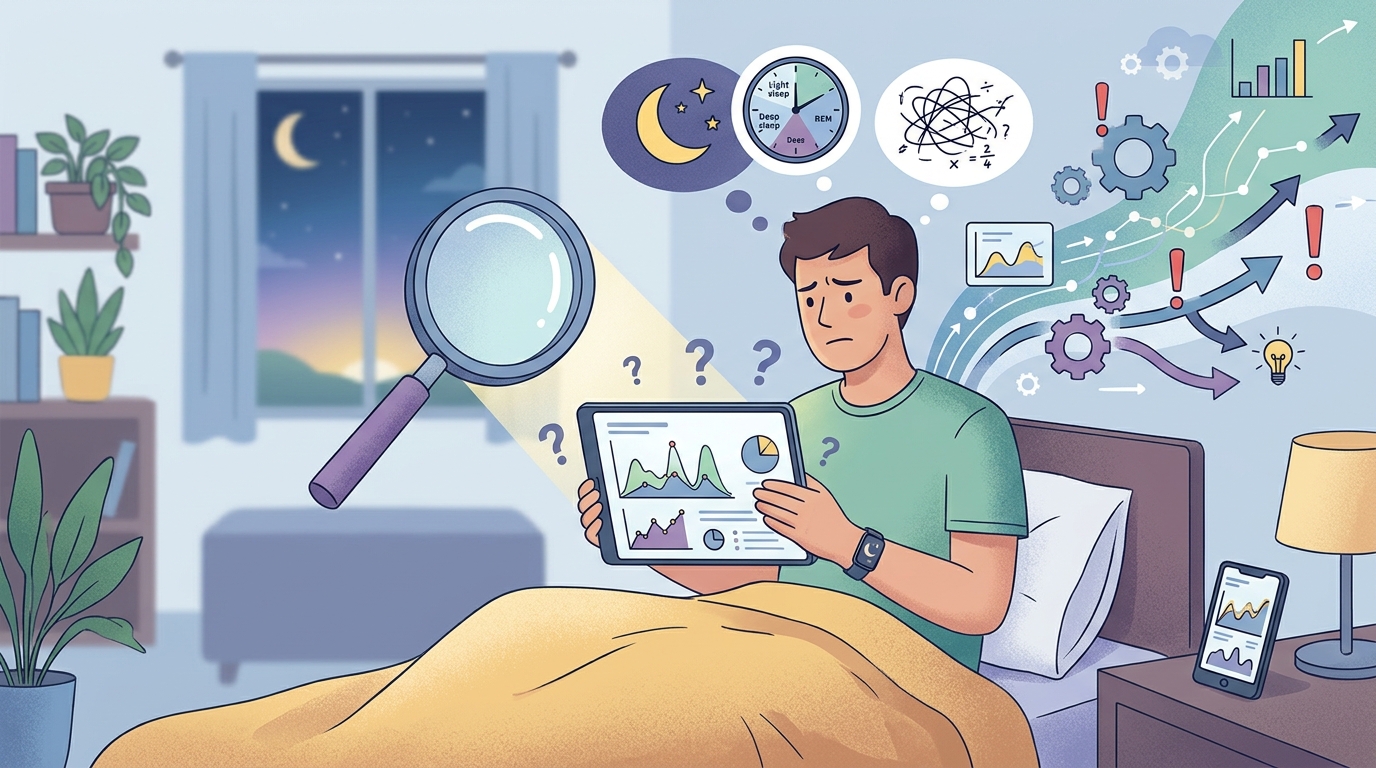
The strongest strategy is to connect three sources of information: what the device estimates, what your daily routine shows, and how you actually function. When all three point toward insufficient sleep or an inconsistent schedule, a simple behavioral adjustment may be worthwhile. When the device reports an isolated stage anomaly without supporting symptoms, restraint is often the more evidence-based response. When persistent symptoms conflict with reassuring app results, clinical assessment deserves priority.
For circadian rhythm management and human optimization, concentrate on the foundations: adequate sleep opportunity, a regular schedule that fits your life, appropriate light exposure, and habits that support sustained rest. Use software to make patterns easier to understand, not to manufacture certainty from imperfect signals.
The best sleep data is not the data that produces the highest score. It is the data that helps you make a sensible decision, recognize the limits of what you know, and seek better evidence when the question exceeds what a wearable can answer.


Comments
Post a Comment